AI workspace for marketing teams
Oblicuo is an AI-powered workspace where marketing teams organize conversations, generate content, and collaborate in one structured environment. Designed for fast-moving teams producing copy, campaigns, and brand assets at scale, it replaces scattered tools with a unified conversational interface.
- Client
- Oblicuo
- Service
- SaaS Platform
- Start date
- Dec 2025
- End date
- Feb 2026
- Duration
- 2 months
- Headquarters
- San Francisco, United States
- Team size
- 1-10 employees
- Industry
- Technology
The challenge
Marketing teams produce more content now than at any point in the last decade, yet the tools behind that output remain fragmented. Campaign managers draft hooks in one chat interface, switch to another for long-form copy, and paste results into shared documents for review. The need for a dedicated AI marketing workspace — one that consolidates ideation, generation, and collaboration — had become impossible to ignore.
Oblicuo's founding team identified a structural gap: generative AI had matured enough to assist with marketing writing, but no product organized that output around how teams actually work — by campaign, by channel, by project. Existing AI chat tools treated every conversation as disposable. Knowledge accumulated nowhere. Collaboration required workarounds.
The brief called for a workspace-first product that matched the organizational rigor of a project management tool with the fluency of a modern AI conversation. The core design challenge: making AI-generated content feel permanent and retrievable, not ephemeral.
Discovery and research
The discovery phase began with eight interviews across three marketing-adjacent roles: content strategists, social media managers, and growth leads. A consistent pattern emerged within the first three conversations. Teams did not struggle with generating ideas — they struggled with organizing, refining, and reusing them. Drafts lived in chat logs nobody revisited. Institutional knowledge vanished when team members changed.
Competitive teardowns of existing AI writing tools revealed a near-universal design assumption: one user, one chat, one session. Collaboration meant copy-pasting outputs into external systems. None of the evaluated products offered a native concept of a shared workspace where conversations accumulated into a reusable knowledge layer.
The insight that reframed the project was direct: the primary unit of value was not the individual AI response, but the workspace — a persistent container where related conversations, accumulated context, and team access converged into a single organizational primitive.
Competitive landscape
The AI writing assistant market clusters around two archetypes. Single-purpose generators produce copy for a specific channel — email subject lines, ad headlines, social posts — through narrow templates and fixed workflows. General-purpose chatbots handle any request but offer no memory, no project structure, and no collaboration beyond a shared link.
A smaller group of tools attempt to combine generation with organization, but they default to document-centric models borrowed from traditional word processors. The result is an interface that feels like writing software augmented with AI, rather than an AI marketing workspace designed from the ground up for team-based content production.
Oblicuo occupied the gap between those categories. The differentiation strategy rested on a single principle: conversations are the content. Instead of generating text to be pasted elsewhere, the product treated each AI exchange as a referenceable, searchable, shareable artifact inside a structured workspace.
Design strategy
Three design principles anchored every decision downstream:
- Workspace gravity — the product had to pull users toward organizing their work, not away from it. Navigation, hierarchy, and naming needed to feel lightweight enough that creating structure never became overhead.
- Conversational permanence — every AI exchange needed to carry the same weight as a drafted document. Chat history was not a log; it was the work product itself.
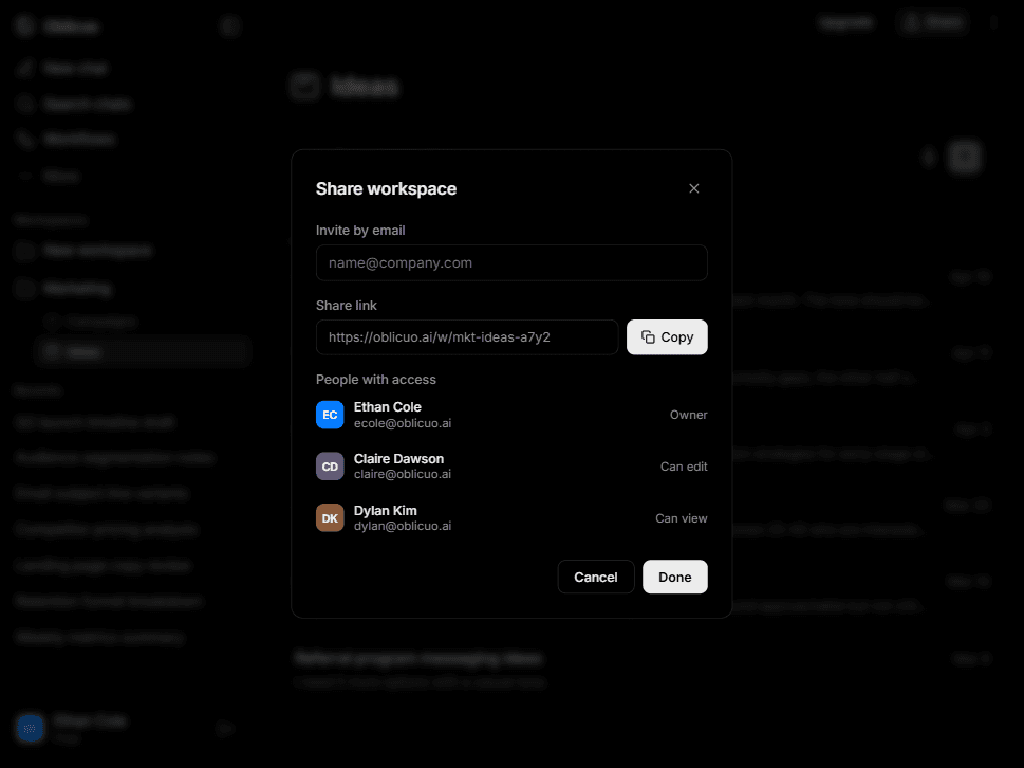
- Ambient collaboration — sharing and permissions could not live behind a settings page. They had to surface naturally in the topbar, in the workspace context, and in the conversation view, visible enough to encourage team use, quiet enough to avoid clutter.
The visual system reinforced these principles through a dark, low-contrast interface that emphasized content over chrome. Typography served as the primary hierarchy tool, with interaction elements receding into the background until explicitly engaged.
Information architecture
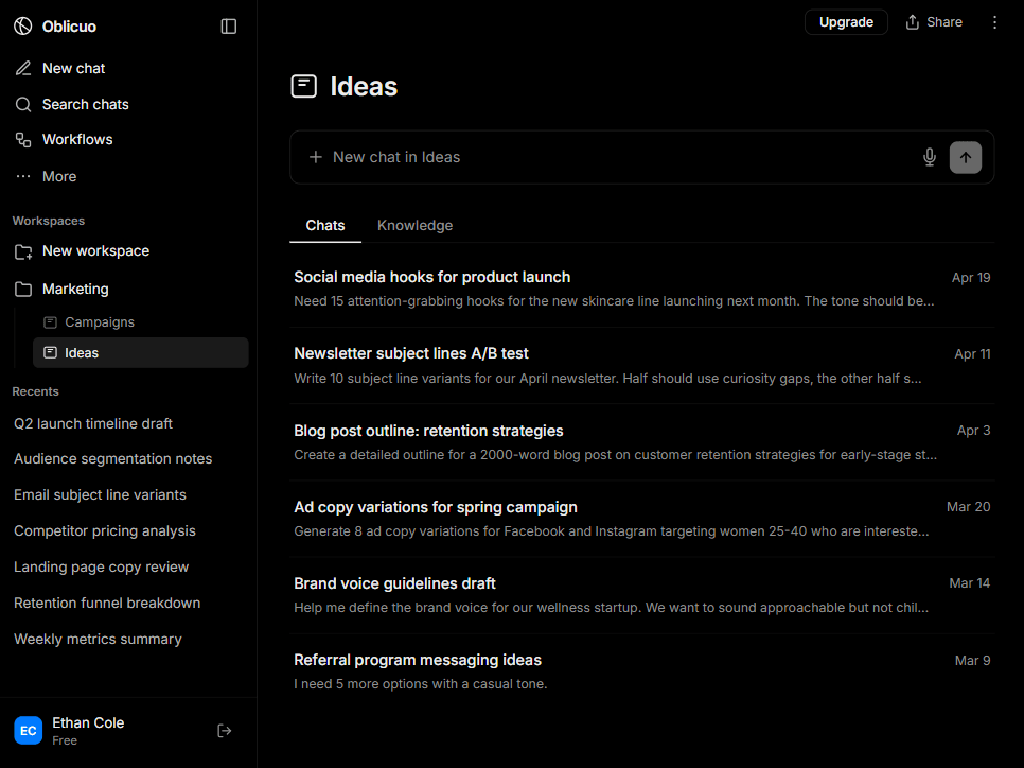
The information model follows a three-tier hierarchy: workspaces at the top, conversation threads in the middle, and individual messages at the bottom. Workspaces function as named containers — equivalent to folders, but carrying collaboration permissions, a knowledge tab, and a shared context layer that persists across conversations.
Within each workspace, the chat list serves as both an index and a timeline. Users scan recent conversations by title and preview text, entering any thread to continue where it left off. The tab structure separating Chats from Knowledge introduces a second navigational axis — one for active work, another for accumulated reference material.
The sidebar complements this with a global view: recent conversations across all workspaces, quick-access navigation items, and a persistent workspace tree that mirrors the team's organizational structure. Breadcrumbs in the topbar anchor context when a user navigates into a specific conversation, providing a clear return path to the workspace index.
Core experience
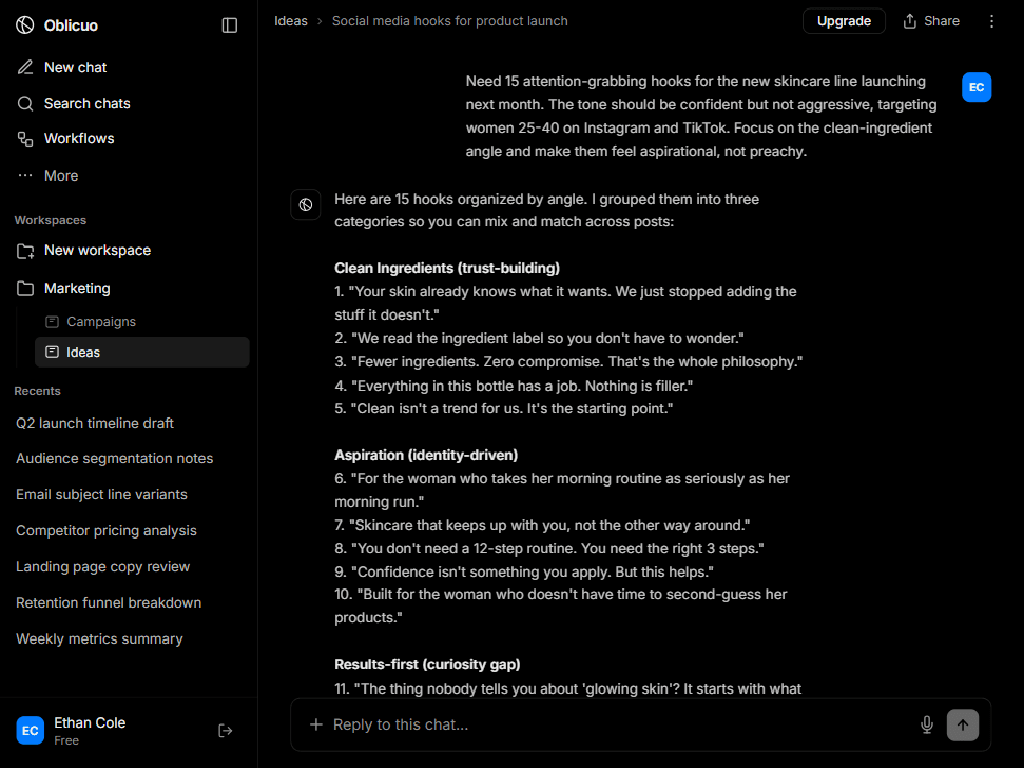
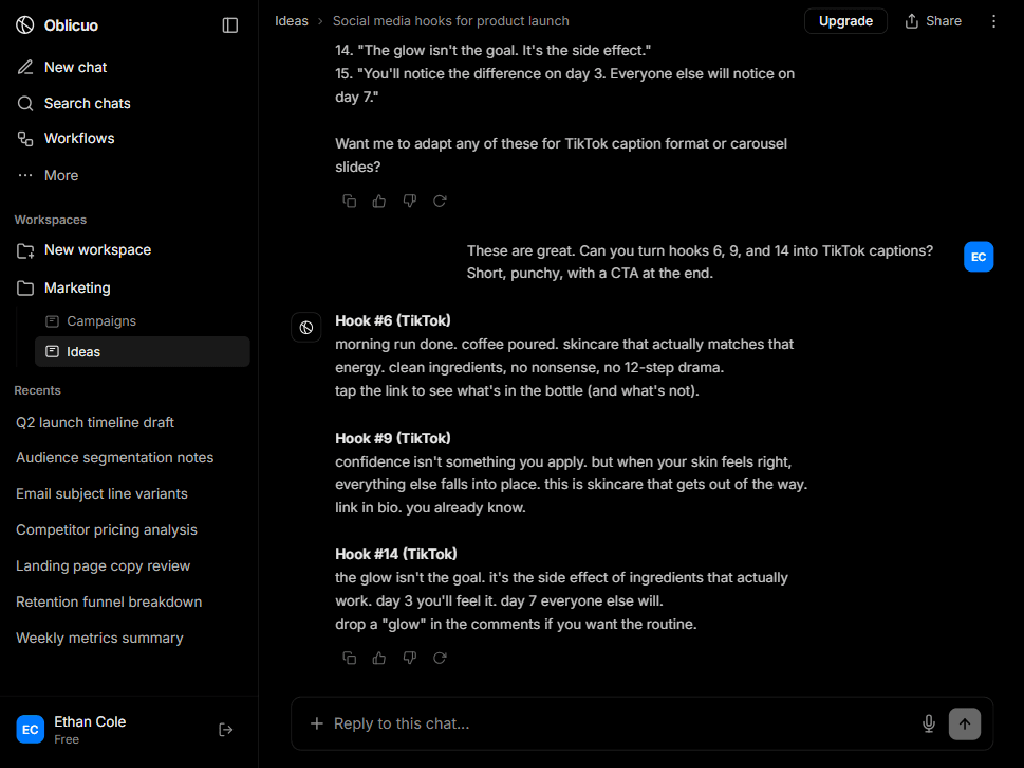
The central interaction is a conversation between a human and the AI assistant, conducted inside a workspace context. A user types a prompt — a request for social media hooks, ad copy variants, blog outlines — and receives a structured response organized by angle or category. The AI does not produce undifferentiated blocks of text; it groups output logically, names each section, and formats content for immediate use.
Follow-up messages refine the output without losing context. A request to adapt specific hooks into TikTok captions produces adapted versions that reference the original conversation. This threading model — where refinement happens in place rather than in a new session — transforms a chat interface into a working surface.
Supporting actions surround each response: copy, regenerate, and feedback signals. These controls are intentionally understated, appearing below each message without competing for attention. The voice input option extends accessibility to hands-free scenarios, acknowledging that marketing ideation often happens away from the keyboard.
Expectations vs. delivery
The original brief described an AI chat product for marketers — conversational, fast, and equipped with good defaults for marketing-specific prompts. The scope expanded materially during the engagement as research surfaced collaboration and knowledge management as equal priorities to content generation.
The delivered product exceeded the brief in three specific ways:
- Workspace model — introduced a structural layer that no competing AI chat product offered at the time, turning disposable conversations into organized, team-accessible assets.
- Share and permissions — elevated the product from single-player to multi-user without adding complexity to the interface.
- Knowledge tab — created a dedicated surface for accumulated reference material, a feature absent from the original specification.
The visual identity also exceeded initial expectations. The dark interface, restrained interaction design, and editorial typography positioned Oblicuo as a professional tool rather than a consumer novelty, differentiating it from the saturated market of brightly colored AI writing assistants.

Results and impact
The workspace-first approach changed how early users interacted with AI-generated content. Instead of generating text and immediately exporting it, teams began treating Oblicuo as the canonical source for campaign copy — keeping conversations alive across weeks and revisiting them as campaigns evolved.
Collaboration adoption exceeded initial expectations. Within the first quarter after launch, the majority of active workspaces had multiple members, indicating that the sharing model successfully shifted the product from individual tool to team utility. The workspace hierarchy — initially considered a power-user feature — became the most-used organizational primitive, with most teams creating several nested workspaces within their first month.
The engagement established a design system and interaction vocabulary that extended well beyond the initial launch scope. Subsequent features, including workflow automation and advanced knowledge management, built directly on the structural and visual foundation laid during this phase.